Fastpay registration and KYC in Australia
 Available in AU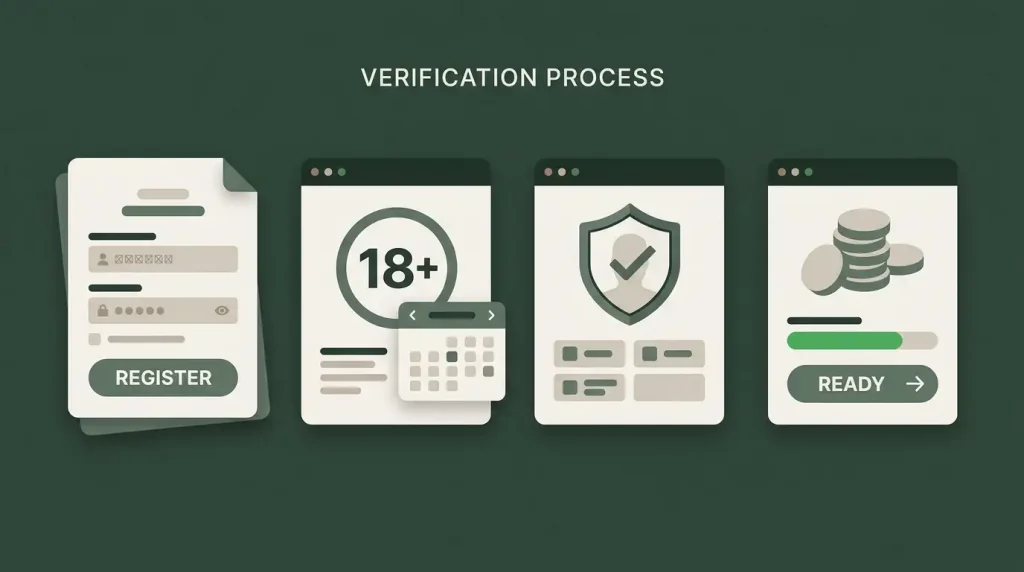
Registration and verification
Fastpay’s current sign-up flow asks new users to provide an email and password, choose account settings such as currency and country, confirm that they are at least 18, and accept the Privacy Policy and Terms and Conditions. That is what can be verified directly from the live registration interface.
KYC is a separate step. Current evidence supports that account or payment verification can be required before withdrawals are processed, but it does not support publishing a universal Fastpay document checklist or a guaranteed verification time. If Fastpay asks for verification, follow the documents and instructions shown for that account at that time. For basic sign-in problems, use the account and login; for the cash-out consequence, see KYC and cash-out.
Related: account and login · withdrawals
What the live form shows
Table of Contents
- Fastpay’s current registration flow starts with a small set of account details
- Registration and KYC are better understood as separate stages
- Do not copy Australian provider KYC rules onto Fastpay’s account flow
- The best KYC preparation is consistent account information, not a speculative document list
- Why verification matters most when money is being withdrawn
- Four registration and KYC mistakes worth avoiding
- Fastpay registration and KYC questions
- What the current sign-up form confirms before any later verification
- What to expect from Fastpay registration and verification
- Fastpay Casino login and account help for Australia
Fastpay’s current registration flow starts with a small set of account details
The visible sign-up interface is useful because it establishes what Fastpay asks users to confirm at the start without requiring assumptions about later verification.
Account credentials and localisation
The current Fastpay registration panel includes fields for an email address and password, together with account selections such as currency and country. The Australian-localised site is available in English – Australia.
Accurate registration data matters because later account and payment checks can become harder if the information used during sign-up does not match the user’s real identity or payment ownership details.
Age and policy confirmation
Fastpay’s live sign-up flow requires users to confirm that they are 18 years old and that they accept the site’s Privacy Policy and Terms and Conditions. That is a verified registration requirement visible in the current interface.
This page focuses on what the Fastpay form itself confirms. Broader Australian rules and operator regulation are covered separately so they are not confused with the current registration interface.
Practical sequence
Registration and KYC are better understood as separate stages
- Create the account with accurate information. Use an email address you control, choose the current country/currency settings offered by the site and make sure the information is consistent from the start.
- Confirm the age and policy statements shown by Fastpay. The current interface requires 18+ confirmation and acceptance of the Privacy Policy and Terms and Conditions.
- Use the account normally unless a verification request appears. KYC should not be treated as a fixed screen that every user necessarily sees at the same moment.
- If verification is requested, follow the live instructions. Fastpay may require account or payment verification before a withdrawal is processed. The requested evidence should come from the current account or official support, not from a generic checklist copied from another casino.
- Confirm completion before relying on a withdrawal timeline. If KYC is pending, the cash-out process can pause before operator approval or payment dispatch.
Australian framework versus Fastpay process
Do not copy Australian provider KYC rules onto Fastpay’s account flow
Australia’s AML/CTF framework has its own customer due diligence obligations for reporting entities that provide designated services. AUSTRAC’s current guidance says initial customer due diligence generally must be completed before a reporting entity starts providing a designated service, and its online-gambling guidance has also emphasised pre-verification requirements for regulated online gambling providers.
Those rules are useful background, but they do not define Fastpay’s own step-by-step KYC process. The sources answer different questions: Fastpay’s live sign-up form confirms the 18+ and policy confirmation, while current account and withdrawal evidence supports only that verification can become a withdrawal requirement. For broader jurisdiction and regulation context, see the Australian regulatory context.
Readers who want the primary Australian source can review AUSTRAC’s initial customer due diligence guidance.
Preparing without guessing
The best KYC preparation is consistent account information, not a speculative document list
Many casino guides publish a standard list of passports, utility bills, selfies and bank-card photos. That can be misleading when the operator has not published the exact same requirement for the account in question. Current Fastpay material does not justify presenting a fixed list here.
A safer preparation method is conceptual: make sure the registration data is accurate, use payment methods that belong to the legitimate account holder, keep access to the email tied to the account and be ready to follow whatever identity or payment-verification request Fastpay presents. If support asks for information, use the current official channel and confirm what the request is intended to verify.
This also helps distinguish verification from ordinary account access. A forgotten password is a login problem; a request to establish identity or payment ownership is a verification problem. Mixing the two can waste time and lead to the wrong troubleshooting steps.
Cash-out impact
Why verification matters most when money is being withdrawn
The clearest operational link between Fastpay KYC and account use is the withdrawal stage. A successful deposit or normal game access does not guarantee that no further check will occur before cash-out.
| Stage | What is verified | What this guide does not assume |
|---|---|---|
| Sign-up | Email/password fields, country/currency selections, 18+ confirmation and policy acceptance are visible in the current Fastpay flow. | That every user completes full KYC during the first registration screen. |
| Account use | The account may continue without a public, fixed KYC schedule being stated. | A guaranteed trigger time for verification. |
| Withdrawal | Account or payment verification can be required before processing. | A universal document list, fee, withdrawal limit or KYC completion time. |
| Support review | Official Fastpay support can clarify the live account request. | That an external review site’s checklist matches the current account requirement. |
For the rest of the payout sequence – request, operator processing and payment-rail arrival – use the dedicated withdrawal guide.
Avoidable problems
Four registration and KYC mistakes worth avoiding
Using inconsistent identity data
Small differences can become important once the operator needs to establish who controls the account or payment method. Enter real, consistent information rather than details chosen for convenience.
Sending documents because a review site says so
Only send information through the current Fastpay verification route or official support process. A generic KYC article is not an instruction to upload sensitive documents.
Assuming a deposit means verification is finished
Current Fastpay evidence allows for verification before withdrawal processing. Treat a successful deposit as a payment event, not proof that all later account checks are complete.
Applying Australian provider rules as if they were Fastpay policy
AUSTRAC rules explain obligations for Australian reporting entities. They are useful context but do not establish Fastpay’s exact documents, timing or internal approval sequence.
Verification FAQ
Fastpay registration and KYC questions
Does Fastpay require users to be 18?
The current sign-up flow contains a checkbox confirming that the user is 18 years old and accepts the Privacy Policy and Terms and Conditions.
Does Fastpay always verify identity at sign-up?
The visible registration interface confirms the initial sign-up fields and age/policy acceptance. Current Fastpay material does not establish that every user completes full identity verification at exactly the same point.
Can KYC affect a Fastpay withdrawal?
Yes. Current evidence supports that account or payment verification may be required before withdrawals are processed. That is why verification should be treated as a possible cash-out dependency.
Which KYC documents does Fastpay require?
This guide does not publish a fixed checklist because the exact current document requirement has not been verified from a Fastpay page for every account. Follow the instructions shown by Fastpay when verification is requested.
How long does Fastpay KYC take?
No universal verification time is claimed here. Use the account status or official support for the current request rather than relying on an unverified static estimate.
Account readiness
What the current sign-up form confirms before any later verification
The current Fastpay sign-up interface visibly asks for core account details including an email address and password, plus localisation fields for currency and country. It also requires the user to confirm being 18 years old and to accept the Privacy Policy and Terms and Conditions before continuing. The interface separately gives existing users a Login route.
These visible fields establish what happens at the initial registration stage, but they do not establish a universal KYC document list. A later verification request can depend on the account and payment context, especially around withdrawals. That is why this page distinguishes the sign-up fields that can be observed now from documents or processing times that must come from the live Fastpay request when one is made.
What to expect from Fastpay registration and verification
Registration begins with a normal account form and a visible confirmation that the user is 18+ and accepts Fastpay’s policies. KYC should then be treated as a conditional verification layer that can matter later, particularly before a withdrawal is processed.
The practical preparation is straightforward: register with accurate information, keep control of the account email, use legitimate payment details and respond only to the exact verification request that Fastpay presents. Do not substitute an internet checklist for the operator’s live instructions, and do not assume Australia’s regulated-provider AML process is automatically Fastpay’s process.
For the wider brand picture, return to the Fastpay Australia review. For the regulatory distinction behind this cautious separation, use the licence and law page.